
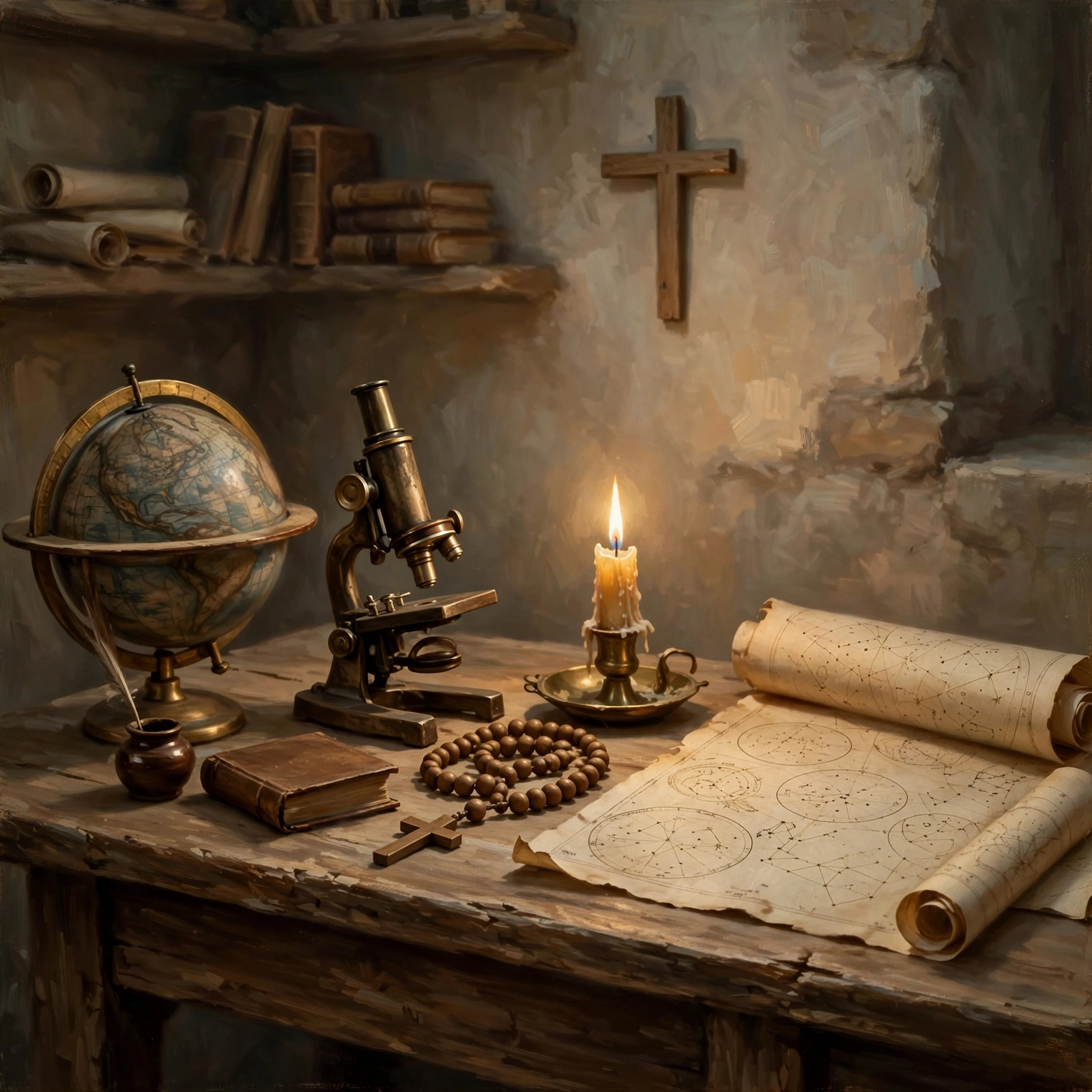
Faith and Science: A Personal Journey
For years, there’s been an idea—whether we thought it true or not—that Christianity and science just can’t go together. Growing up in a small town in South Africa, I remember the controversy when it was announced that the evolution theory would be introduced in our school curriculum. My biology teacher, also a Christian, explained that even if we didn’t agree with it, we simply had to study it to pass—there was no choice. This incident deepened my sense that science and Christianity were “opposites”.
When I studied biology as a first-year student at university, Darwin’s theory of evolution sometimes made sense, but I struggled with its tension against the Biblical creation story. Reading about Darwin’s complex relationship with Christianity made me more sceptical of a theory so at odds with the Biblical creation story I was raised with. Studying anything contrary to my beliefs felt like betraying my faith. Christian magazines I read offered apologetic answers to scientific challenges like the Big Bang theory and evolution. Like many believers, I was wary of exploring science too deeply, worrying it would challenge my Christian faith and force me to choose between the two.
But interestingly, I never felt the same conflict with other scientific fields like physics, mathematics, chemistry— even though these too are science. I rarely considered whether the people behind those theories were Christians or not. Although Einstein wasn’t religious, he was not quite an atheist—famously saying: “Science without religion is lame; religion without science is blind.” I believe Einstein’s reverence for law and order in the cosmos reflected something profound about God's greatness, and through his statement, he acknowledged the place of faith.
Isaac Newton was a Christian—unorthodox, perhaps—but he didn’t see any conflict between science and the Bible.
Just considering these three giants—Einstein, Newton, and Darwin—who shaped our understanding of the world, I realised the religious beliefs of the scientist behind a theory shouldn’t matter and that discomfort about science vs. faith shouldn’t stop us. Science is not the opinion of one person; science is, as the Science Council defines: “the pursuit and application of knowledge and understanding of the natural and social world following a systematic methodology based on evidence.”
Even in the Bible, non-Jewish wise men (Magi, essentially astrologers) who presented Jesus with gifts at his birth recognised the star and, from their knowledge of the prophecies at the time, found Jesus as the Messiah. Their act at Jesus’ birth showed he came for the Gentiles too, and even they played a role in the story of faith and science working together.
Maybe the big controversy is because the Bible appears to clash with certain scientific theories— like creation. But if we look closer, wouldn't that mean we should also reject modern medicine, mathematics, geology, and astronomy—subjects also referenced in the Bible but evolved in understanding over time? We easily accept those differences because we know that context is important and biblical understanding was limited by the knowledge of the age. In our previous post Is the Bible the Truth or has Science proven it False? we explored this topic in great detail and found that science and the Bible can serve different—but harmonious—purposes.
Through my personal journey, I believe it’s time to move beyond the myth that science is “secular/evil/anti-faith.” Through the ages Christian scientists have been on the pursuit of truth so let’s look at the profound impact Christianity has had on the development of modern science.
Christianity: Foundation and Catalyst for Modern Science
Philosophical Groundwork:
Christianity’s belief in a logical, lawful Creator who designed an ordered universe gave scientists the confidence to study and understand nature through observation and reason. As historian Noah Efron notes, “almost all historians agree that Christianity—Catholicism as well as Protestantism—moved many early-modern intellectuals to study nature systematically.”
Institutional Support: Universities, Libraries and Hospitals
During the Middle Ages, the Church founded Europe’s first universities: Bologna (1088), Paris (c.1150), and Oxford (c.1167).
These institutions produced influential names like Robert Grosseteste, Albert the Great, Roger Bacon, and Thomas Aquinas, helping establish the scientific method.
The Church supported astronomy for over centuries. Historian J.L. Heilbron wrote that the Church gave more financial support to astronomy than any other institution. Today, the legacy continues through the Vatican Observatory and the Pontifical Academy of Sciences.
The Church funded the construction of libraries and monasteries helped preserve classical knowledge and advance practical science. St Benedict is known as the “godfather of libraries.”
Monasteries were also the primary providers of healthcare before 1300, establishing Europe’s first hospitals, developing medical herbs, and combining spiritual care with practical treatment.
The Church’s investment in these institutions laid the groundwork for modern science, medical care, and education.
Christian Scientists Who Revolutionised Science
There have been amazing Christian scientists who made interesting and revolutionary scientific developments. Let’s just look at a few from the Medieval through to the 20th century.
Medieval Period:
Roger Bacon (1219–1292): “Pioneer of Experimental Science,” is the innovator of the scientific method, and medieval forerunner of evidence-based science.
Thanks to theologian and philosopher Thomas Aquinas’ work during this period, merging faith and reason, he influenced centuries of Christian scientific thought.
Renaissance and Scientific Revolution:
Nicolaus Copernicus (1473–1543): championed the heliocentric model.
Galileo Galilei (1564–1642), a devout Christian, called the “Father of Modern Science.”
Blaise Pascal (1623–1662): Mathematician and physicist, invented the hydraulic press and syringe—namesake of the “pascal” unit of pressure.
Robert Boyle (1627–1691): Devout Christian; formulated Boyle’s Law, a fundamental principle of physics and chemistry.
19th & 20th Century:
Gregor Mendel (1822–1884): Augustinian friar, “Father of Genetics.”
Jean-Baptiste Lamarck (1744–1829): Jesuit-educated, proposed the first evolutionary theory before Darwin.
Father Georges Lemaître (1894–1966): Priest, physicist and founder of the Big Bang Theory.
Louis Pasteur (1822–1895): Pioneered pasteurisation, germ theory and vaccination.
Michael Faraday (1791–1867) and James Clerk Maxwell (1831–1879): Influential physicists, pioneered electromagnetic theory, integrated faith and science.
Francis Collins (b. 1950): Born again Christian, leader of the Human Genome Project, advocate for faith and science compatibility.
Why Christian Contribution to Science Matters
Christianity helped create the very philosophical and institutional framework science is built on: universities, libraries, hospitals, and the foundational belief in a rational, orderly universe. Christian thinkers have pursued truth across cultures, leaving an incredible mark on modern science.
My journey challenged me to open my mind to new scientific developments; this enriched my spiritual life and broadened my understanding. Our minds and intellect are gifts from God, and He can use scientists from every background to reveal more about Himself—if we keep seeking with open hearts and minds.
In today’s information-overload world, discerning truth is harder than ever. The Bible tells us to use our intellect for discernment and critical examination—not blindly accept everything (1 Thessalonians 5:21; 1 John 4:1; Acts 17:11). Created in God’s image, we’re given rationality, creativity, and logical reasoning (Genesis 1:26–27). Following Jesus’ example in growing “in wisdom and in stature and favour with God and man” (Luke 2:52), Christians should continue making a mark in the scientific world. God still creates through us today—through science and other developments. Faith and science can work together to reveal God’s glory. Science can be an act of worship!